
The Commercial Authority Gap
Why capability alone never closes it, and why the second half of 2026 is the moment to address it

"The rooms that matter form their impressions before the conversation begins."
Let me tell you about a client I worked with recently.
She is, by any objective measure, exceptional. Several letters after her name. A published book. A track record that includes achievements most professionals in her field will never reach. She holds positions of genuine significance, is well known within her sector, and is deeply respected by the people who know her work.
She is also, by a conservative estimate, leaking fifty thousand pounds (£50,000) a year in revenue.
Not because she is undercharging. Her fees are correct. She has priced herself at the level her credentials warrant, and she has not apologised for it. She is doing many of the right things, the things most advice would tell her to do.
The problem is different, and it is more structural than any individual tactic. She is not attracting enough of the right business. The enquiries that reach her are not consistently from clients who can meet her at her level. The opportunities that find her are not consistently from the rooms where her standing warrants a seat. She is credible, accomplished and visible. She is also positioned below the level she has earned.
When I conducted her commercial authority review, the specific finding was this: she is positioned as a community figure when her credentials, her fee structure and her ambitions are corporate. The two positions can coexist. But they require different signals, different platforms, different language and different channels. When a corporate decision maker researches her, and they do research, thoroughly, before they commission anyone, what they find is a picture of a respected community leader. Warm. Impactful. Trusted. But not immediately legible as the practitioner who belongs in their boardroom at their budget.
The gap is not in what she has built. The gap is between what she has built and what the market can currently see. And that gap has a number attached to it. In her case, fifty thousand pounds (£50,000) a year. Conservatively.
That is a commercial authority gap. And here is the uncomfortable truth this article is really about: capability alone never closes it.
Let us talk about money for a moment
Before I get into some definitions, a word about something that makes many accomplished professionals uncomfortable.
There is a tendency, particularly among people who genuinely care about their work, to find conversations about money slightly distasteful. The work is the point, the reasoning goes. The impact is the point. The money follows.
Except that often, it does not follow. Or it follows at a level far below what the expertise deserves. And here is the honest position: if a business cannot attract the right amount of work at the right level, it is not operating as a business. It is operating as a hobby with invoices. A hobby needs enthusiasm. A business needs positioning.
The professionals and organisations I work with are not struggling with capability, credibility or commitment. They are struggling with the fact that the market’s picture of them does not match the reality of what they deliver. And every month that mismatch persists, it costs them. Specifically. Measurably. In pounds.
What commercial authority actually is, and what it is not
I feel it’s important to be clear about some definitions, because the confusion I see between adjacent disciplines is the single biggest reason this problem goes unaddressed.
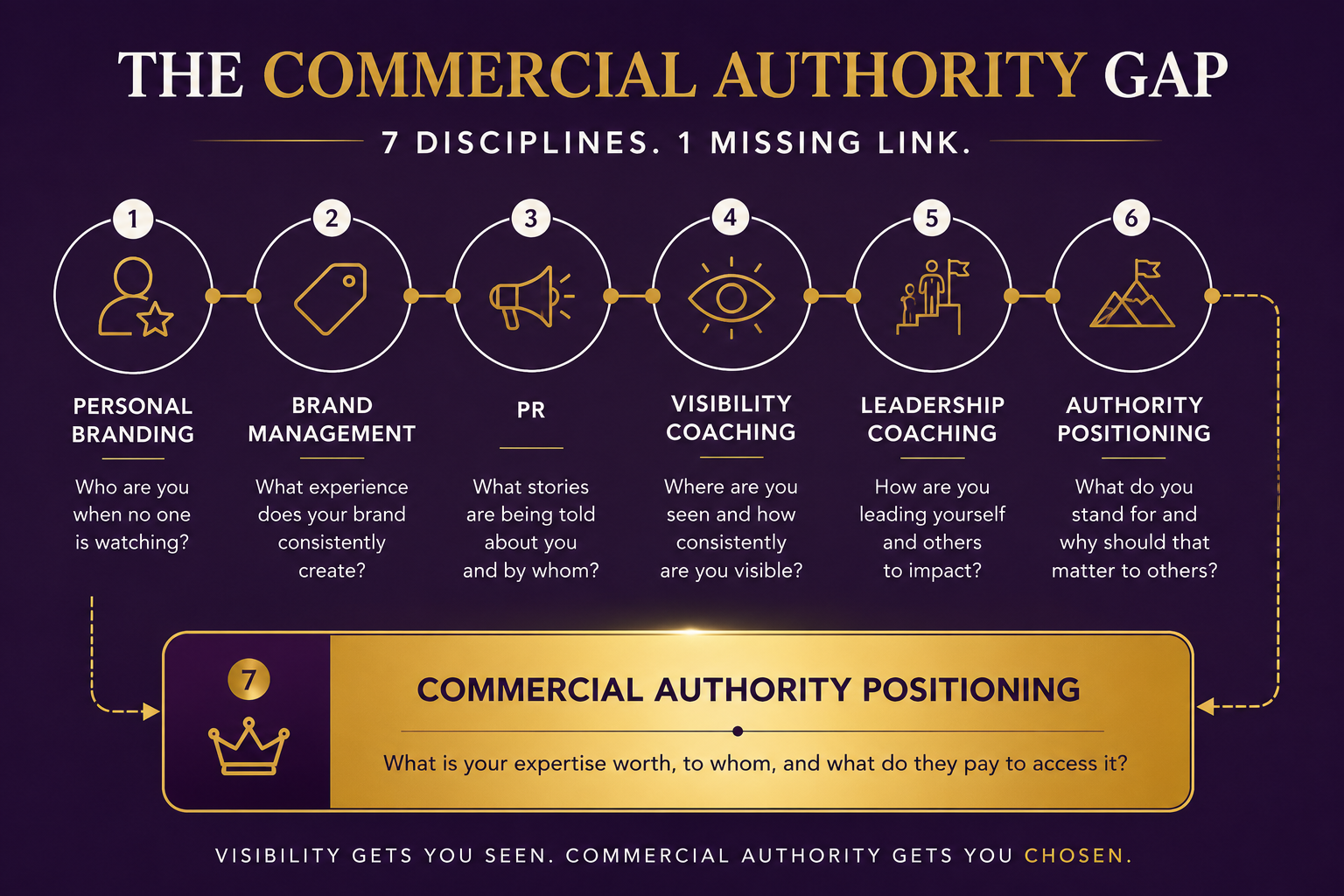
Personal branding is about recognition. It asks: when someone encounters me, do they remember who I am and what I stand for? It concerns visual identity, tone, and consistency of story across platforms. Personal branders do important work, and the good ones do it with real skill.
Brand management is about consistency and protection. It asks: is the brand, whether personal or organisational, being presented coherently across every touchpoint, and is its reputation being maintained? It is stewardship. Necessary, valuable, and fundamentally about maintaining a position that already exists.
Public relations is about third party validation. It asks: what are credible external sources saying? It works through earned media and press coverage, giving positioning an external confirmation that self-generated content cannot provide.
Visibility coaching is about reach. It asks: am I appearing in enough places, in front of enough people, often enough?
Leadership coaching is about behaviour. It asks: how am I showing up, in the room, in decisions, in communication?
Authority positioning, the discipline I have worked in for years, is about perception architecture. It asks: is the right audience positioned to see me as a credible, senior expert in my specific field?
Commercial authority positioning asks a different question to all of these. It asks: is the way I am positioned in the market producing the commercial outcomes my expertise deserves?
The distinction is the direction of travel. Every other discipline starts with the person or the brand and works outward. Commercial authority positioning starts with the commercial outcome, the revenue, the fee level, the quality of pipeline, the calibre of opportunity, and works backward to identify what in the positioning is failing to produce it.
And whilst all these disciplines can be part of the overall architecture of commercial authority positioning, it is, in practice, closer to change management than to branding. It requires diagnosis. A structured programme. Sustained implementation over months. And measurement against commercial outcomes rather than engagement metrics. When I run this work with organisations, and this applies to organisations every bit as much as to individuals, the process resembles an organisational change programme far more than it resembles a rebrand.
"Every discipline asks a different question. Only one starts with the commercial outcome."
The evidence: why positioning now determines who gets paid
This is not a theoretical argument. The evidence that positioning drives commercial outcomes at the decision maker level is now substantial and specific.
The Edelman LinkedIn B2B Thought Leadership Impact Report, which surveyed approximately 3,500 management level professionals across seven countries, found that 73% of decision makers say an organisation’s thought leadership content is a more trustworthy basis for assessing its capabilities than its marketing materials. Nearly three quarters of the people who make buying decisions trust demonstrated authority over anything a company says about itself.
The same research found that 60% of senior decision makers and executive leaders are willing to pay a premium to work with organisations that demonstrate their expertise through valuable thought leadership. Read that again. The majority of senior buyers will pay more, for the same underlying capability, when the authority position supports it. That is the pricing dimension of the commercial authority gap, quantified.
And the threat side is equally documented: 70% of executive leaders say a piece of thought leadership has led them to question an existing supplier relationship, and a quarter of those buyers went on to end or significantly reduce that relationship. Positioning is not only how new business is won. It is how existing business is taken.
One more finding worth sitting with. At any given moment, roughly 95% of potential buyers are not actively in market. They are not searching, not shortlisting, not ready. Which means the overwhelming majority of your future clients are forming their impression of you now, quietly, passively, through what they encounter about you, long before they have a budget or a brief. When they do come in market, they do not start from zero. They start from the impression that has already formed. The professional or organisation whose commercial authority was established during the quiet period is the one who gets the call when the noise begins.
The three places the gap shows up
In review after review, for individuals and organisations alike, the commercial authority gap manifests in three specific places. Often all three at once.
The first is pricing power. Not that fees are set too low. Many of my clients have priced correctly. The problem is that the positioning does not make the premium feel inevitable to the buyer. They hesitate. They negotiate harder than they would with someone whose authority felt unambiguous. The Edelman data tells us the majority of senior buyers will pay a premium where the authority is demonstrated. The corollary is equally true: where it is not demonstrated, the same buyers apply pressure.
The second is pipeline quality. The enquiries arriving are not consistently from buyers who can meet the offer at its actual level. This is precisely what my recent client was experiencing: community level enquiries for a corporate level practice. Both audiences valued her. Only one of them could pay her. For organisations, the equivalent pattern is attracting procurement conversations at the commodity end of the market while the premium mandates go to competitors whose positioning claimed that territory first.
The third is opportunity sequencing, the subtlest and most expensive of the three. It is the pattern of being respected, shortlisted, considered, and called second. Not because the person called first was more capable. Because their commercial authority was more legible. The decision maker already knew, with confidence, what they were buying. In competitive situations, legibility beats capability with unsettling frequency.
Why this matters more now than it ever has
There is a structural reason this conversation has become urgent rather than merely important.
The way buyers form judgements has changed. Around 60% of searches now end without a click, with AI generated summaries answering the question before anyone reaches a website. More than half of consumers have begun replacing traditional search with generative AI tools when researching people, services and organisations. The research phase that used to take a buyer a week of calls and recommendations now takes minutes, and it is increasingly mediated by systems that synthesise whatever public signals exist about you.
This cuts both ways, and sharply. If your public footprint accurately reflects your authority, the compressed research window works in your favour: the buyer arrives at the conversation already convinced. If your footprint undersells you, if it tells the community story when you are selling the corporate offer, if it describes the 2019 version of your organisation, if it is thinner than that of your competitors, then the judgement forms against you before you know the conversation was happening.
The window between capability and recognition used to be forgiving. Reputation travelled slowly, through networks and word of mouth, and a strong reputation in the room could outrun a weak one on paper. That forgiveness is gone. The paper, the digital footprint, the indexed citations, the demonstrated authority, now arrives in the room first.
The six month window
Which brings me to timing, and to why I keep returning to the second half of 2026 specifically.
The rooms that matter, budget committees, commissioning conversations, board appointments, shortlists, partnership decisions, tend to crystallise their thinking around January. Not overnight and not all at once. But the impressions informing those decisions are forming now, in the quiet months, among the 95% who are not yet in market.
Commercial authority is not built quickly, and anyone who tells you otherwise is selling you the personal branding version of the problem. It is built through a sequenced programme: diagnosis, repositioning, platform alignment, authority content, media readiness, external validation. Each stage compounds on the last. Six months of deliberate work produces a measurably different external picture. Six weeks does not.
Which means July is not early. July is exactly on time. The professional or organisation that starts the work now arrives in January 2027 with the positioning already established, while their competitors are just beginning to think about it.
"Six months. Six stages. The rooms that matter decide in January."
One way to start
If you have recognised something of yourself, or your organisation, in this piece, there is a simple starting point.
The Commercial Authority Index takes around five minutes. It gives you a structured view of how effectively your expertise is translating into market presence, positioning clarity, authority signals and commercial opportunity.
Take it before you talk yourself out of it. Because the gap does not close by itself. And every month it stays open has a number attached to it.
Sources: 2024 and 2025 Edelman LinkedIn B2B Thought Leadership Impact Reports, a survey of approximately 3,500 management level professionals across seven countries; Forrester buyer research 2024; Capgemini generative AI consumer research 2025.
Understand your current authority position
The Commercial Authority Index measures how effectively your expertise is translating into market presence, positioning clarity, authority signals and commercial opportunity.

Merisha Stevenson
Merisha Stevenson is a BBC broadcaster, executive facilitator and strategic moderator, and the founder of The Commercial Authority. Her work focuses on authority positioning, leadership communication, reputation and the relationship between expertise, recognition and commercial opportunity.
Related Insights
The Translation Gap
Why complex expertise becomes commercially difficult to recognise, remember and recommend, and why clarity is central to authority positioning.
Are You a Peer or a Project?
Why powerful networks and impressive rooms do not necessarily create authority, and the difference between being valued, recognised and chosen.
Why Some Experts Become the Default Voice of an Industry
Why certain experts become the obvious choice for media, speaking and commercial opportunities, and how trust, recall and social proof build authority.