
When Borrowed Authority Expires
What nobody tells you about becoming independent after institutional success

"Institutions do not just employ us. They introduce us."
There is a form of authority that nobody talks about because almost nobody recognises it while they have it.
It does not belong to you. Not entirely. It is lent to you by the institution you work within, woven so seamlessly into your professional identity over years and decades that it becomes almost impossible to distinguish from the authority you have genuinely built yourself.
It travels ahead of you in the form of a brand name on your email address. It sits behind you in the form of an organisation whose reputation precedes every conversation you have. It speaks before you do, in the title on your business card, the structure that surrounds you and the implicit assumptions that form in a room before you have said a single word.
It is structural authority. Borrowed authority. And for most people who have built significant careers inside significant institutions, it is doing far more work than they realise.
Until the day it expires.
The biggest mistake is not leaving
The biggest mistake many senior professionals make is not the decision to leave.
It is the assumption that the market will receive them in exactly the same way once they do.
That assumption is understandable. It is also, almost universally, wrong. And the distance between that assumption and the reality of what actually happens is where some of the most capable, credentialled and genuinely formidable professionals I have ever encountered have found themselves completely unprepared.
The tragedy is not discovering this after you leave.
The tragedy is that by then, you have already lost the best six months you had to prepare.
To get there, she had to be exceptional
Before we go any further, it is worth being precise about who we are talking about. Because the people this piece is about did not arrive at senior leadership by accident or by comfort.
According to McKinsey’s most recent Women in the Workplace report, women represent nearly half of all entry-level employees. By the time you reach the C-suite, that proportion has fallen to 29 percent, unchanged for eleven consecutive years. For every 100 men promoted to their first management role, 81 women make the same leap. For women of colour, that number drops to 54. In the UK specifically, women account for just 32 percent of executives in the top leadership teams of the FTSE 100.
Which means that the woman who has made it to the C-suite, or to a partnership, or to the leadership of a significant public institution, has not simply worked hard. She has worked harder, been scrutinised more closely, had to prove herself more repeatedly and navigated more structural friction than most of the people around her will ever fully understand.
She is not someone who needs to be told she is capable. She has been demonstrating her capability, under pressure, in environments that were not always designed with her in mind, for the entirety of her career.
By the time she reaches the senior leadership table, she is formidable. She understands power, process and the architecture of large organisations in ways that take decades to develop. She knows how decisions actually get made. How to move rooms. How to read the dynamics of a board. How to make things happen in environments where things are not always straightforward.
She is generating millions, sometimes hundreds of millions, for the organisations she works within.
And at some point, quietly, the thought arrives.
I could do this for myself.
What the scaffolding was doing
The decision to leave is rarely impulsive. It is usually the product of years of quiet consideration. A growing awareness that her expertise, her network and her capability are assets she has been deploying in service of someone else’s enterprise. A conviction that she has both the ability and the appetite to build something of her own.
So she leaves. Deliberately. With clarity of purpose and the kind of strategic intent she has applied to every significant decision in her career.
What she does not fully see, in that moment of departure, is this.
For twenty years, she has been introduced before she speaks.
Her title has gone ahead of her.
Her organisation has gone ahead of her.
Her email address, carrying a brand name that opens doors, has gone ahead of her.
The infrastructure around her, the assistants, the budget, the corporate backing, the implied weight of the institution, has been arriving in rooms before she has.
And then one Monday morning, it is just her.
No title attached to a name the market already trusts. No organisation lending its credibility to hers. No structural scaffolding communicating her level before she has had the opportunity to demonstrate it herself.
Just her expertise. Her thinking. Her network. Her track record.
All of which are genuinely remarkable.
None of which are automatically visible in the way the institution made them.
And the door, which used to open with a particular kind of ease, does not open the same way anymore.
Sometimes it does not open at all.
The first time it happens, she assumes they are busy.
The second time, she wonders whether she sent the email to the wrong address.
By the fifth time, she begins asking a question she has not had to ask herself in twenty years.
Have I overestimated my value?
She has not.
She has overestimated how much of her authority belonged solely to her.
The ambiguity of founder
When a senior professional steps away from an institution and begins describing herself as a founder, she steps into a word that covers an almost incomprehensible range of realities.
Founder means Elon Musk. It also means someone working alone, trying to figure out how to get their first client. It means the person who has raised significant institutional investment and the person who is wondering where next month’s revenue is coming from.
C-suite communicates something precise. It tells a room immediately what level of seniority to expect, what kind of decisions this person has been trusted with, what the weight of their experience is likely to be.
Founder communicates almost nothing.
For someone who spent decades in an environment where titles were precise and hierarchies legible, this ambiguity is profoundly disorienting. She is now operating with a professional identity that is, by its very nature, undefined. And she is doing so without the budget, the brand, the team and the structural backing that previously created the conditions for the conversations she is used to having.
There is no process for this. There is no ladder. There is just the open market, and the question of how effectively she can make her expertise legible to people who do not yet have a clear picture of what she is and what she is worth.
This is not one story. It is a pattern.
Over the past year I have had versions of this conversation repeatedly. And what strikes me, every time, is how consistent the experience is across people who are, on the surface, very different.
The C-suite leader stepping into a portfolio career. The senior partner leaving a professional services firm after decades. The NHS director who has led services affecting millions of people and now finds herself having to explain her credentials to a room that does not already know them. The police chief. The military leader. The university vice chancellor. The senior civil servant.
All of them carry genuine, deep, hard-won expertise. All of them discover, to varying degrees of surprise, that the institutional scaffolding was doing more of the communication work than they had ever needed to examine while it was in place.
One conversation in particular has stayed with me. A former executive who had led a division responsible for hundreds of millions of pounds. Someone whose track record was, by any objective measure, exceptional.
Within six months of leaving, she found herself doing something she had never had to do at that level before.
Explaining why someone should book an introductory call.
Nothing about her capability had changed. Everything about how the market perceived her had. Because the market had not known her. It had known her organisation. And without that organisation behind her, she was, in the eyes of the people she was now trying to reach, essentially starting from the beginning.
That is the reality of borrowed authority expiring.
The grief nobody names
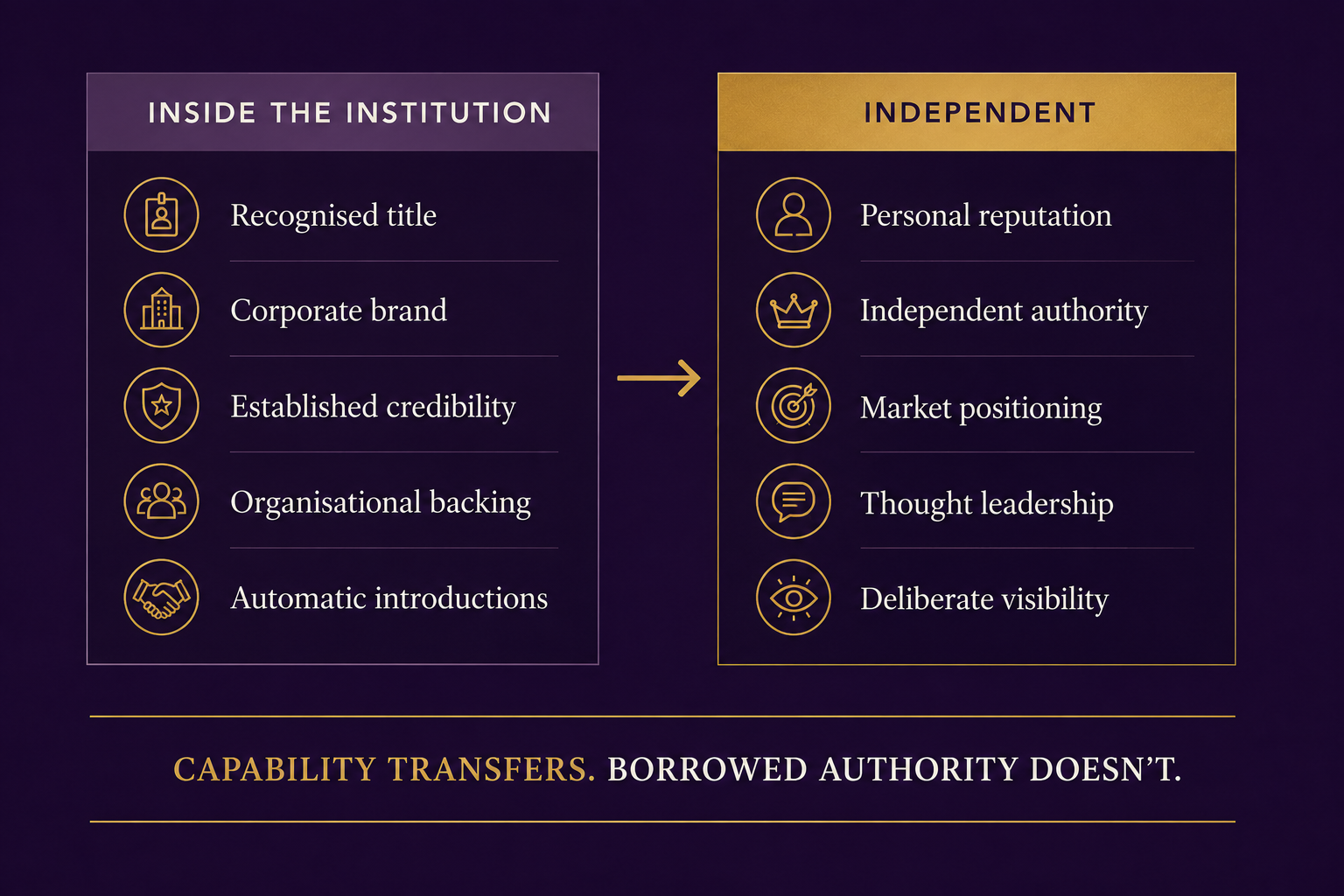
I want to say something that does not often get said in professional conversations, because professional conversations tend to focus on strategy and solutions rather than the experience underneath them.
What I am describing is a form of loss.
Not dramatic loss. Not the kind that announces itself. But the quiet, disorienting loss of an identity that has been built over decades and is now, in its current form, no longer available.
The title is gone. The institutional identity is gone. The automatic credibility that came from both is gone. The diary full of invitations that arrived because of who she worked for, gone. The introductions that happened because of the brand name on her email address, gone.
Nobody prepares you for that.
And because the professional world does not have much language for this kind of transition, many of the people going through it assume something is wrong with them, with their capability, with their approach, when in fact what they are experiencing is simply the gap between borrowed authority and the independent authority they have not yet had the opportunity to build.
That gap is not a reflection of their worth.
It is a positioning problem.
And positioning problems have solutions.
This is not a women’s problem. It is an institutional one.
Although the statistics at the beginning of this piece are about women in senior leadership, the dynamic I am describing is not exclusive to women.
It applies to anyone who has built significant authority inside a significant institution and then stepped outside it. The difference, and it is a significant one, is that for women who have reached senior leadership, the journey to get there has already required navigating structural disadvantage at every stage. The pipeline has been thinning them out since their first promotion.
Which means the expertise they carry when they leave is, if anything, even more robust and hard-tested than the statistics would suggest. And the borrowed authority they are leaving behind is authority they had to work considerably harder to access in the first place.
That context matters.
The repositioning does not begin on your last day
Here is the insight I wish more people received before they make the transition rather than after.
The professionals who navigate this shift most effectively are almost always the ones who begin the work of building independent authority before they leave the institution. Not after. While the structural scaffolding is still in place. While the brand is still lending its credibility. While the title is still doing its work.
That is the window in which the foundations of an independent professional identity can be laid most efficiently. Because borrowed authority, while you still have it, gives you access. To rooms, to conversations, to relationships that can be built on your own terms if you are deliberate enough to use that access intentionally.
The repositioning does not begin on your last day.
It begins while you are still inside the institution. With clarity about who you are becoming, independent of the structure. With deliberate work to ensure that the people who matter most to your professional future understand your expertise in a way that is attached to you, not to the organisation you are leaving.
Too many people discover this after the fact. After the exit. After the first few months of finding that the market is not quite reading them the way they expected. After the quiet realisation that formidable in one context does not automatically translate to recognised in another.
The question worth asking now
Institutions do not just employ us.
They introduce us.
Which means one of the most important questions any senior professional can ask is not whether they are ready to leave.
It is whether the market has learnt to recognise them before they do.
It is one of the reasons I built The Commercial Authority.
I kept meeting extraordinary people who were not struggling with capability. They were struggling with translation, with making expertise that was real, deep and genuinely valuable legible to a market that no longer had the institutional context to interpret it for them.
Build the authority that travels with you
Authority Positioning helps established professionals translate institutional credibility, expertise and track record into a market position that belongs to them.

Merisha Stevenson
Merisha Stevenson is a BBC broadcaster, executive facilitator and strategic moderator, and the founder of The Commercial Authority. Her work focuses on authority positioning, leadership communication, reputation and the relationship between expertise, recognition and commercial opportunity.
Related Insights
Are You a Peer or a Project?
Why powerful networks and impressive rooms do not necessarily create authority, and the difference between being valued, recognised and chosen.
The Translation Gap
Why complex expertise becomes commercially difficult to recognise, remember and recommend, and why clarity is central to authority positioning.
The Commercial Authority Gap
Why expertise, visibility and commercial recognition do not always align, and how to identify the gap between capability and market authority.